University of Tartu Students Advance Bee Monitoring with AI
We're incredibly thankful to share the outstanding work of three student teams from University of Tartu who chose Gratheon as their machine learning course project. This work was completed as part of the Machine Learning course (MTAT.03.227) taught by Dmytro Fishman, Associate Professor at University of Tartu. Their contributions are moving us closer to our mission of protecting bees through AI-powered monitoring.
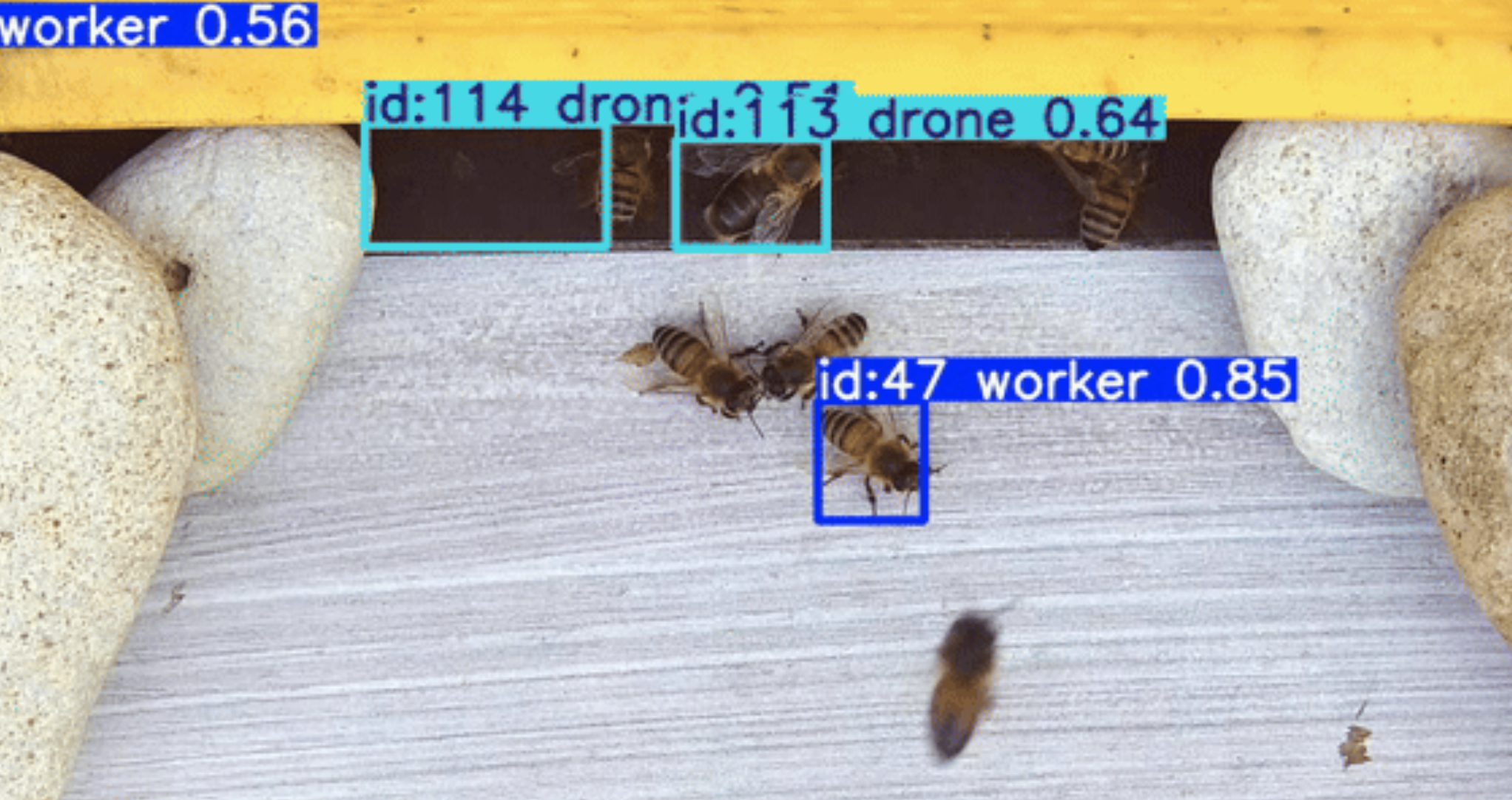

Team T30 - Bee Type Detection (Vol 2)
Kreete Kuusk, Danni Zhang, Jasper Luik, and Rasmus Mirma developed a YOLOv10 model achieving 96.7% precision in distinguishing drone bees from worker bees. Their sophisticated approach included manual dataset curation, intelligent augmentation strategies, and automatic image splitting - critical for understanding colony health dynamics.
GitHub: https://github.com/KreeteKuusk/Bee-type-detection-ML2025
Team T14 - Hornet Detection System
Albert Unn, Kadi-Liis Kivi, Karen Roht, and Otto Kase tackled a life-or-death challenge. Hornets can destroy bee colonies within hours. Their YOLOv8-nano model (96.7% precision, 91.2% recall) provides early warning capabilities, manually labeling over 1,250 images and creating production-ready deployment for edge devices.
This detection system is crucial for beekeepers as early detection can mean the difference between saving or losing an entire colony.
GitHub: https://github.com/OttoKase/HornetDetector
Team T41 - Multi-Class Bee Detection on Video
Norman Tolmats, Mihkel Kulu, Joonas Tiitson, and Markus Kivime pushed the boundaries further by detecting pollen-carrying bees in real-time video streams. Their work on weakly supervised learning and auto-labeling pipelines (30k+ images) demonstrates the future of scalable AI solutions.
GitHub: https://github.com/bukyt/beeDetection
Impact on Gratheon's Mission
What amazes us most is not just the technical excellence, but their commitment to open-source principles and practical deployment. These students went beyond academic requirements - they created production-ready tools that will directly impact beekeepers and their colonies.
To all eleven students: Your work embodies our mission to "harmonize humanity with nature." You've contributed to something bigger than any individual project - you're helping protect pollinators that are essential for global food security.
Special thanks to Associate Professor Dmytro Fishman for fostering an environment where students can tackle real-world challenges and contribute to open-source projects that make a tangible difference and teaching assistants that help out with that - Mari-Liis Allikivi, Chingiz Alikhanov, Ali Zeynalli, Hasan Tanvir, Dzvinka Yarish.
Check also Presentations teams made.
Learn More
Thank you for choosing to make a difference. 🌻🐝